
China Opens Its Markets. Can Nigerian Businesses Compete at Home and Abroad?
By ASCIR · · 8 min read
Originally published by Catherine Omartins on 23 October 2026.
China Opens Its Markets. Can Nigerian Businesses Compete at Home and Abroad?
China's zero-tariff policy presents new export opportunities for Nigeria, but growing Chinese commercial participation at home raises a fundamental question: is Nigeria building the productive capacity to compete?
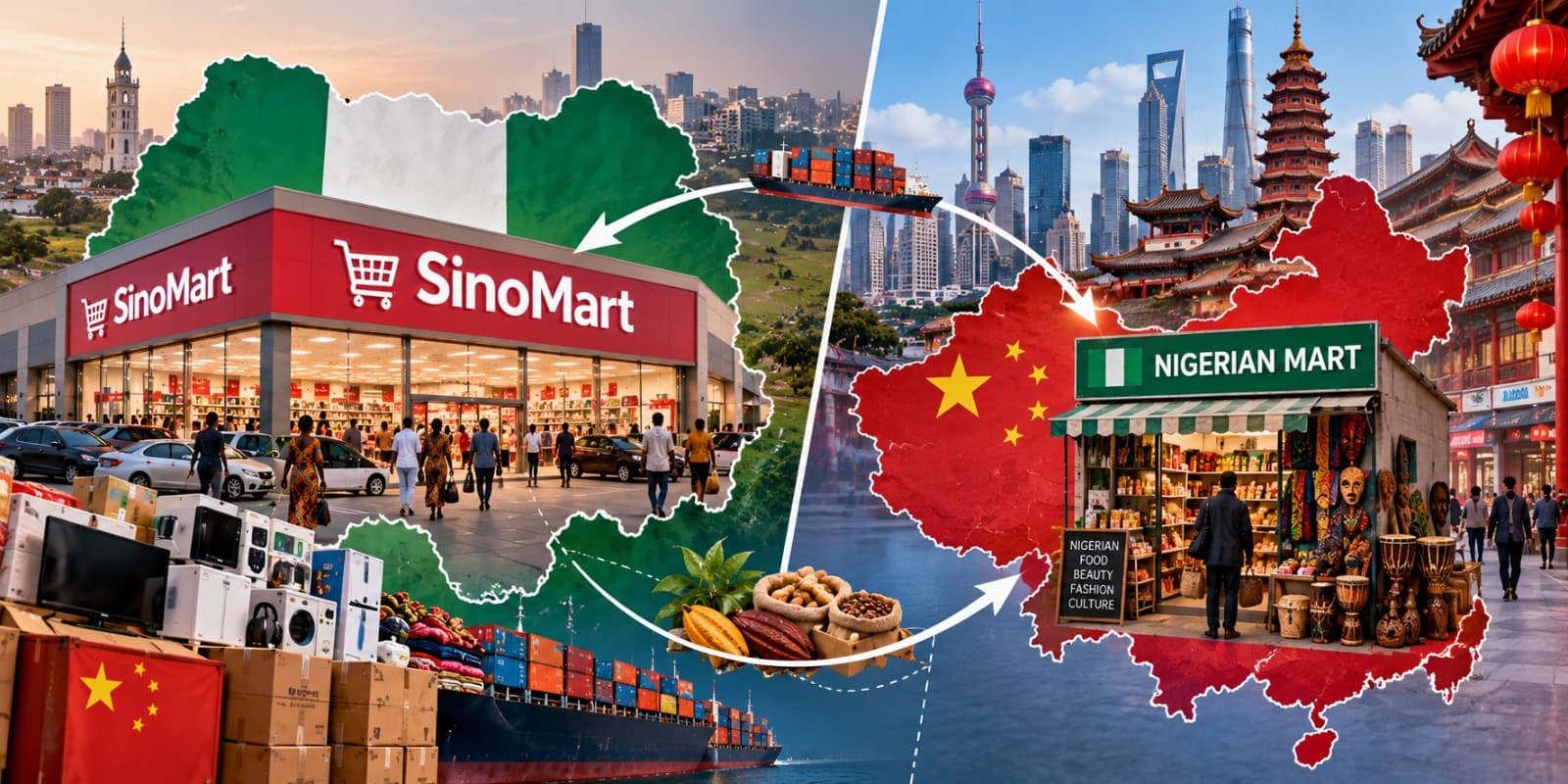
The opening of a new SinoMart outlet at The Palms Shopping Mall in Ibadan has sparked a debate that extends beyond the arrival of another retail store. Its wide range of products and competitive prices have attracted consumers, while its presence has raised concerns among Nigerian traders about growing Chinese participation in the domestic retail market.
The debate reflects a wider tension in Nigeria's economic relationship with China. Nigeria seeks greater access to the Chinese market and more investment from China, yet Nigerian businesses face increasing competition from Chinese companies operating at home.
This tension has become more relevant following China’s expansion of its zero-tariff policy for African countries.
An Open Chinese Market, but Can Nigeria Supply It?
On May 1, 2026, China introduced zero-tariff treatment for qualifying products from the 20 African countries with which it maintains diplomatic relations that are not classified as least-developed countries, including Nigeria. The measure runs until April 30, 2028. Combined with the existing arrangement for 33 African least-developed countries, the policy extends zero-tariff treatment to products from all 53 African countries that maintain diplomatic relations with China. https://english.www.gov.cn/policies/policywatch/202605/01/content_WS69f45e35c6d00ca5f9a0ac01.html
The distinction is important. China is not making Chinese goods entering Nigeria tariff-free. The policy concerns African products entering China. For Nigeria, the opportunity is therefore on the export side: Nigerian producers can potentially reach Chinese consumers without the tariff barriers that previously applied to qualifying products.
However, access to a market does not automatically translate into competitiveness. Nigerian producers must be able to meet quality standards, maintain consistent supply, produce at sufficient scale and deliver goods at competitive prices.
These challenges were also highlighted at an international seminar on the policy held in Abuja in August 2026. Participants emphasised the need to increase productive capacity, improve quality, strengthen supply chains and move beyond exporting raw materials towards products with greater value added. https://fmino.gov.ng/nigeria-takes-the-lead-as-africa-positions-to-harness-chinas-zero-tariff-policy-for-industrial-transformation/
The opportunity presented by China therefore raises a fundamental question: what can Nigeria produce competitively for the Chinese market?
From Suppliers to Competitors
While China is opening its market to African products, the relationship between Chinese businesses and Nigerian consumers is also changing.
Traditionally, much of the trade relationship followed a relatively straightforward pattern: Chinese manufacturers produced goods, Nigerian traders sourced and imported them, and local businesses distributed them through markets across Nigeria. This created commercial opportunities in importing, wholesaling and retailing Chinese products.
That division is becoming less clear.
Chinese companies are increasingly moving further along the supply chain, including into distribution and retail. Reporting on the growth of Chinese-owned retail businesses in Nigeria has highlighted concerns among Nigerian traders who say that businesses that once supplied them are increasingly moving closer to the final consumer. https://businessday.ng/business-economy/article/china-supplied-nigerias-traders-now-its-coming-for-their-customers/
SinoMart provides a visible example of this shift. Its presence in Ibadan illustrates how Chinese-backed retail businesses are competing directly for Nigerian consumers. This does not, by itself, demonstrate that Nigerian traders cannot compete. It does, however, highlight the differences between businesses operating at different scales and with varying access to supply chains. https://inibadan.com/blog/2026/09/09/sinomart-in-ibadan-everything-you-need-to-know/
The Competition Is About More Than Price
It is tempting to frame the situation simply as Chinese businesses versus Nigerian traders. That overlooks the structural factors shaping competition.
Product sourcing, purchasing volumes, access to manufacturers, logistics, warehousing and the number of intermediaries all influence the final price of a product. A small Nigerian retailer purchasing through several intermediaries operates under different conditions from a larger company that sources directly from manufacturers and buys in significant quantities.
Price competition therefore reflects not only what happens inside a shop, but also the supply chain behind it.
Some Nigerian traders are adapting by travelling directly to Chinese manufacturing centres or using digital wholesale platforms to reduce their dependence on intermediaries. Yet these approaches require capital, information and market access that smaller businesses may lack.
The Centre for the Promotion of Private Enterprise has also raised a related concern. In September 2026, the organisation called for a review of foreign participation in Nigeria’s retail sector, arguing that the government needs to distinguish between foreign investment that adds capital, technology and productive capacity and foreign participation in retail activities where Nigerian businesses already have substantial involvement. https://cppe.org.ng/cppe-raises-concern-over-growing-foreign-incursion-into-nigerias-retail-trade/
This distinction deserves serious consideration without reducing the debate to a choice between welcoming all foreign competition or excluding foreign businesses.
What Happens When Businesses Disappear?
Nigerian businesses are not isolated from the wider economy. Traders pay rent, use local banking and payment systems, pay for transportation and other services, employ workers and spend their income within their communities.
When businesses close, the consequences can extend beyond individual owners. Fewer enterprises may mean fewer jobs, reduced demand for local services and weaker economic links between businesses and communities.
Reporting on the closure of major retail outlets in Nigeria has illustrated how changes in the retail sector can affect workers, suppliers, neighbouring businesses and customer traffic.https://www.vanguardngr.com/2026/03/nigerias-n2-5trn-mall-economy-takes-hit-as-shoprite-completes-shut-down/
This does not mean every existing business must be shielded from competition. Businesses must also adapt, improve efficiency and respond to consumer preferences. However, the disappearance of domestic enterprises should not be treated simply as an inevitable consequence of consumers choosing cheaper products.
The broader question is what replaces the economic activity that is lost.
The Consumer Cannot Be Ignored
Consumers are equally important to this debate. For households facing rising living costs, lower prices and greater choice have real value. Choosing a cheaper product does not necessarily reflect opposition to Nigerian businesses; it may simply reflect limited purchasing power.
Expecting consumers to pay more solely to preserve businesses that cannot offer comparable value is unrealistic.
The challenge is therefore to avoid presenting affordable goods for consumers and the survival of Nigerian businesses as mutually exclusive objectives. A stronger domestic economy should be capable of supporting both.
Achieving this requires addressing the conditions under which Nigerian businesses operate.
The Cost of Competing in Nigeria
Businesses cannot become competitive simply because they are told to compete.
Electricity, transportation, logistics, finance and regulatory costs all affect the final price of a product. These factors are part of the wider business environment in which Nigerian firms operate.
The electricity problem alone illustrates the scale of the challenge. According to World Bank Enterprise Surveys data for Nigeria, approximately 82% of surveyed Nigerian firms experienced electrical outages in 2025. Unreliable electricity can raise operating costs, particularly for businesses that depend on generators or other alternatives to maintain their operations. https://data.worldbank.org/indicator/IC.ELC.OUTG.ZS?locations=NG
When Nigerian producers spend more on electricity, transport and financing, their products may become more expensive before they even reach the market. These structural disadvantages make it difficult to compete with businesses benefiting from more developed manufacturing and supply networks.
This is why the response cannot simply be to tell Nigerian businesses to work harder or become more efficient. Their competitiveness is also shaped by the wider economic environment.
Economic Transformation Is the Long-Term Answer
Debates about Chinese competition can become preoccupied with which foreign businesses should be allowed to operate in Nigeria. Although regulation has a role to play, focusing exclusively on foreign participation risks overlooking the underlying conditions that limit domestic competitiveness.
If Nigerian businesses struggle to compete on price, quality or scale, the long-term solution cannot be permanent protection from competitors. Nigeria needs economic transformation that improves the conditions under which businesses produce and compete.
This requires reliable electricity, better roads and logistics, affordable productive finance, efficient customs and regulation, stronger manufacturing capacity, and investment in technology and skills.
It also requires changing the structure of the economy. An economy in which businesses largely compete over the distribution of imported goods will remain vulnerable to companies with stronger international supply chains. By contrast, an economy that develops the capacity to manufacture, process, package and distribute goods competitively can build businesses capable of serving domestic consumers and exporting internationally.
China's zero-tariff policy is relevant to this transformation. The opportunity extends beyond exporting existing raw materials: Nigeria can use improved market access as an incentive to develop its capacity to produce and export higher-value goods.https://fmino.gov.ng/nigeria-takes-the-lead-as-africa-positions-to-harness-chinas-zero-tariff-policy-for-industrial-transformation/
Making Foreign Investment Work for Production
Foreign investment can form part of that transformation, but the type of investment matters.
A foreign company that imports finished products and sells them locally contributes to commerce and provides goods for consumers. A company that manufactures locally, develops Nigerian suppliers, trains workers, transfers technology or produces for export can also help build domestic productive capacity.
Neither model is automatically beneficial or harmful in every circumstance. The important question is how investment contributes to Nigeria's wider economic objectives.
The same principle applies to China. Nigeria can benefit from Chinese capital, technology, manufacturing experience and access to supply chains while also ensuring that Nigerian firms are able to participate in those opportunities.
The aim should not be to remove competition. It should be to ensure that competition takes place in an economy capable of producing competitive Nigerian businesses.
Conclusion
SinoMart's arrival in Ibadan and China's expanded zero-tariff policy may appear to be separate developments. They are not.
One shows what deeper Chinese commercial participation can look like inside Nigeria. The other creates greater access for Nigerian products to the Chinese market. Together, they reveal the two sides of Nigeria’s economic relationship with China: Nigeria must compete in its own market while also developing the capacity to compete in China’s.
The answer cannot be to keep domestic businesses permanently insulated from competition. Nor can it be to assume that market access alone will transform Nigeria’s economy. The more difficult task is to build the conditions under which Nigerian businesses can produce efficiently, operate at scale, create jobs and sell beyond the domestic market.
China has opened greater access to its consumers. The question for Nigeria is whether it can build the productive capacity to make use of that opportunity.