Why China-Egypt Relationship Matters for Global South Cooperation
What does China-Egypt cooperation have to do with the rest of the Global South?
A lot, if you look beyond the headlines.
In their latest joint statement, issued as Chinese President Xi Jinping paid a state visit to Cairo to celebrate 70 years of diplomatic ties, China and Egypt described their partnership as “a model of cooperation between major developing countries based on solidarity among the countries of the Global South.”
That may sound like diplomatic language. But behind it lies a relationship built over seven decades — one not defined by who gives and who receives, but by what two major developing countries can build together, offering a different way of thinking about cooperation between nations.
Respect for Core Interests and Strategic Autonomy
The relationship’s value as a model is first grounded in the two countries’ respect for each other’s core interests and independent diplomatic choices.
Both sides support each other on issues involving their core interests and major concerns. China recognizes the vital importance of the Nile to Egypt, while Egypt consistently adheres to the One-China principle.
The relationship itself has roots in the Cold War era, when China and Egypt supported each other at a time when both were seeking greater independence in their foreign policies. That history also established an important principle that has endured: cooperation and mutual support do not require interference in each other’s internal affairs.
Particularly noteworthy is the statement’s reference to Egypt’s principle of strategic balance. China expressed appreciation for Egypt’s adherence to this principle, recognizing its pursuit of an independent and balanced foreign policy amid great-power competition, without demanding that it “choose sides.”
This goes beyond respect for Egypt’s diplomatic choices. It reflects a broader recognition of the right of developing countries to maintain their strategic autonomy. At a time when many Global South countries face pressure to choose between major powers, China-Egypt relations offer a different approach: respecting each other’s right to chart their own course.
From Projects to Development Capacity
The model is also reflected in the concrete areas of cooperation, showing how Global South countries can strengthen their development capacity through strategic alignment and industrial cooperation.
Both sides agreed to deepen the alignment between the Belt and Road Initiative and Egypt’s Vision 2030, with the goal of helping Egypt develop into a regional hub linking Asia, Africa and Europe in industry, logistics, clean energy and the digital economy.
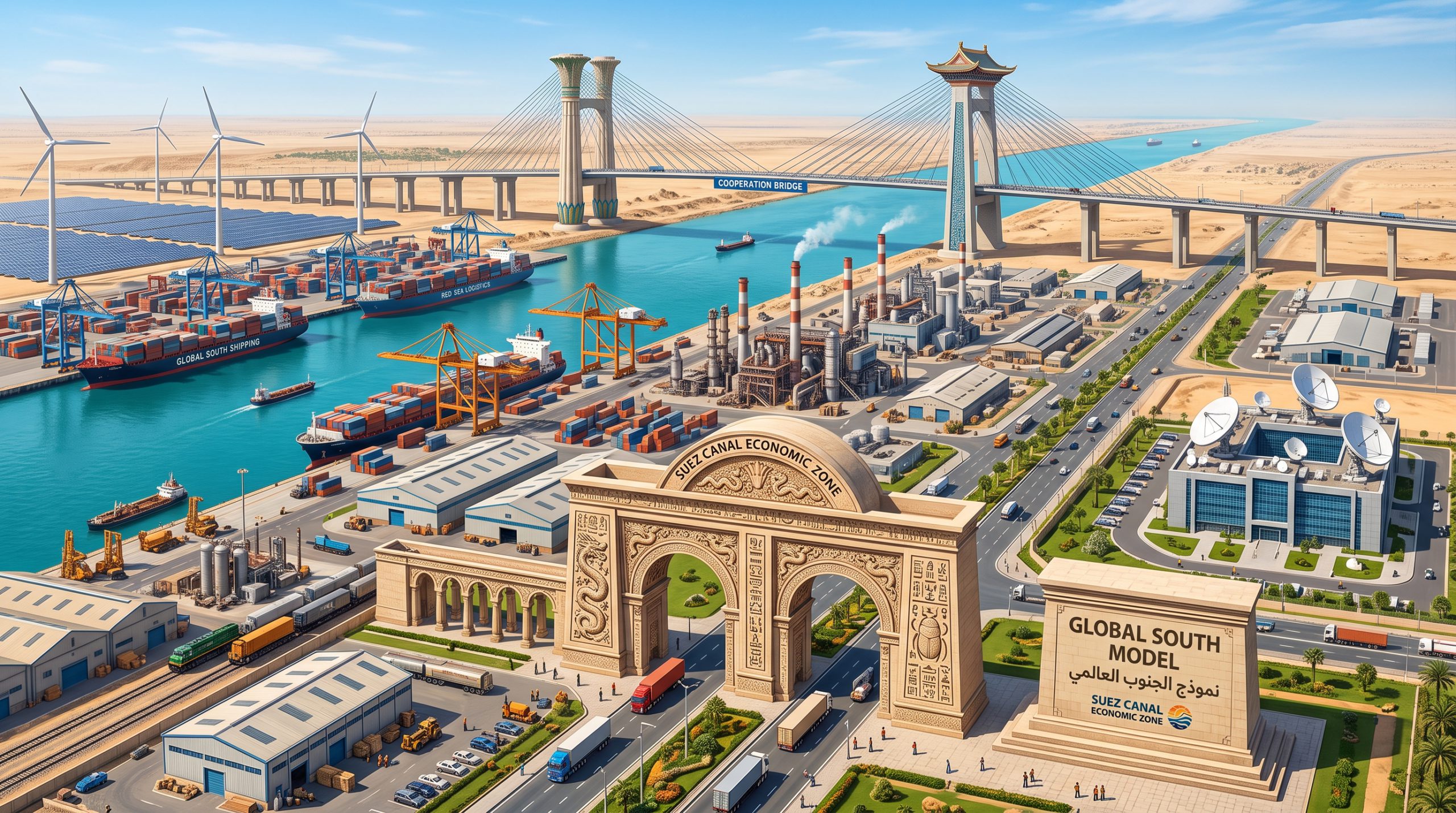
The Suez Canal Economic Zone is an important example of this evolution. Chinese companies have established manufacturing and industrial operations there, turning the zone into a platform connecting investment, production, trade and logistics. As cooperation deepens, the focus is increasingly shifting from individual projects toward building integrated industrial chains and expanding Egypt’s productive capacity. The broader goal is to help Egypt make greater use of its strategic location and workforce, while creating more opportunities for local production, employment and technology development.
Cooperation has also moved beyond traditional infrastructure into industrial capacity building. Renewable energy, electric vehicles, semiconductors, cloud computing and the digital economy are among the areas where the two sides plan to deepen localized cooperation.
Financial cooperation is also part of this effort. The two sides have renewed and expanded their bilateral currency swap agreement and encouraged greater use of their national currencies in trade and investment settlements, providing support for deeper cooperation while strengthening economic resilience.
Speaking with One Voice for the Global South
The significance of China-Egypt cooperation also extends to their shared efforts to shape a changing international order.
Both countries emphasize stronger coordination on global governance and the interests of developing countries and the wider Global South. Their cooperation therefore goes beyond bilateral relations and reflects a shared interest in giving developing countries a stronger voice in international affairs.
This coordination can be seen in their positions at the United Nations, where the two countries have often worked to strengthen coordination on major international and regional issues and to uphold the interests of developing countries.
A clear example is the Palestinian issue, where China and Egypt have repeatedly coordinated their positions at the United Nations, calling for an immediate ceasefire in Gaza, greater humanitarian access and the implementation of the two-state solution. Their coordination reflects a broader effort to ensure that the Palestinian question remains on the international agenda and that the legitimate rights of the Palestinian people are represented in global diplomacy.
Egypt’s participation in BRICS has also created another platform for closer communication with China on issues including development, reform of global governance and the interests of emerging economies. At the same time, China and Egypt have maintained communication through other multilateral platforms, including the Shanghai Cooperation Organisation, where Egypt became a dialogue partner, creating additional channels for coordination with the wider Global South.
On reform of the international system, the two sides support making international and financial institutions fairer and more representative of developing countries. This goes directly to a core aspiration of the Global South: having a greater voice in shaping international rules.
Gains for Both Countries and Regions
China has a saying: “A good example goes a long way.” For both China and Egypt, becoming a model for Global South cooperation would mean more than simply earning praise.
For Beijing, it would bring wider recognition to its experience of working with developing countries and perhaps encourage others to explore similar partnerships. For Cairo, it would reinforce recognition of its independent and balanced foreign policy, as well as its strategic importance as a major Arab and African country. For the wider regions, a successful China-Egypt partnership could offer a practical example of how countries can work with different partners to expand development opportunities, strengthen regional connectivity and create more space for economic growth.
That is the real power of being a model: you do not have to ask others to follow. You simply show them that another path is possible.
Quanbin Zheng, CGTN
